Boiler losing pressure? Here's why it happens and what to do next
If your boiler keeps losing pressure, the short answer is this: something is letting water or air escape the system. It could be a simple fix — a quick top-up using the filling loop takes about two minutes — or it could point to a hidden leak, a faulty valve, or a component that's wearing out. The tricky part is knowing which one you're dealing with.
We work with homeowners across Sussex every week, and pressure loss is one of the most common calls we get. Most of the time it's straightforward. Occasionally it's a sign something bigger is going wrong. This guide will help you tell the difference.
What does boiler pressure actually mean?
Boiler pressure is simply the balance of water and air within your boiler's sealed system. Think of it like a bicycle tyre — there's a correct amount of pressure needed to do the job. Too little and the system can't push hot water around your radiators. Too much and the pressure relief valve kicks in to let some out.
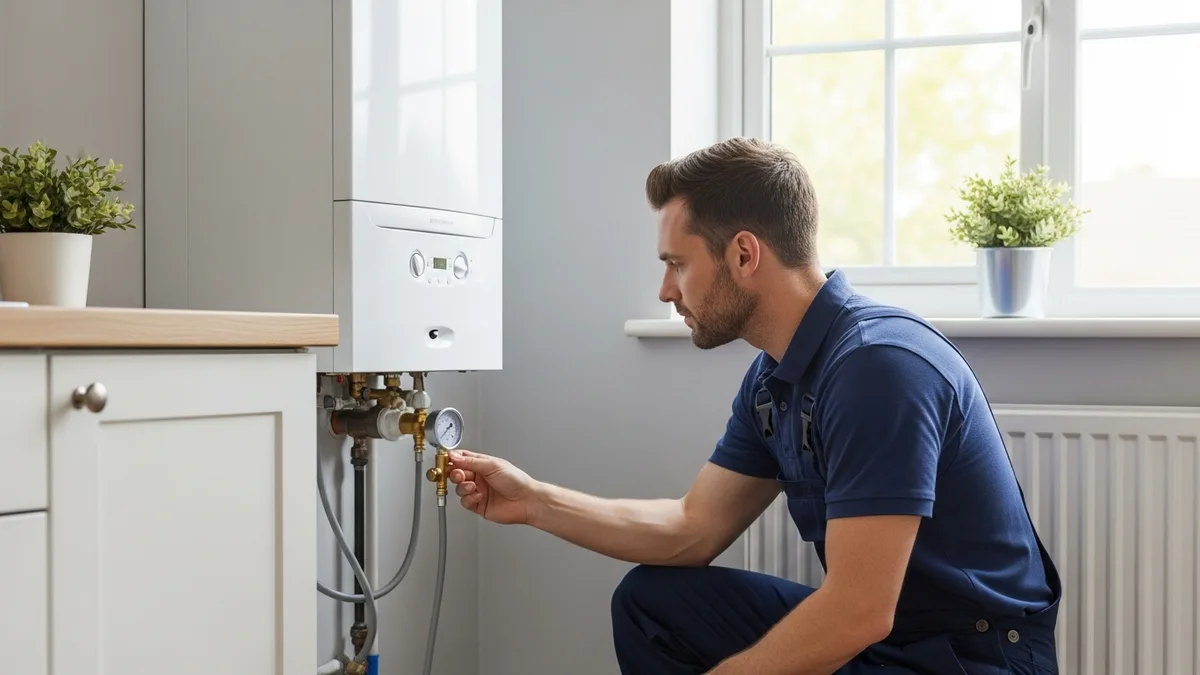
As a guideline, most sealed systems operate at around 1.0–1.5 bar — always check your manual for the exact figure for your specific boiler. There's a gauge on the front of your boiler (or sometimes a digital display) that shows you where the needle sits. Green zone means you're fine. Below 1 bar and you've got a pressure problem.
One thing worth knowing: the pressure level is higher while the boiler is running because water expands as it heats up — its volume increases by around 4%, which raises the bar reading on your boiler. So a reading of 1.8 bar when the heating is on is normal. The same reading when the system is cold overnight is not.
The most common reasons a boiler loses pressure
1. You recently bled your radiators
This is the most innocent cause, and it catches people out all the time. If you've recently bled your radiators and your boiler has switched off due to low pressure, that's likely the cause — when you bleed radiators, you release air from the system, which causes the pressure level to drop. Just repressurise using the filling loop and you're done.
2. A leak somewhere in the system
This is where it gets trickier. The pressure drop usually comes down to one of a few usual suspects — a leak in the system is the number one cause, and even a tiny leak in a radiator valve or a hidden pipe can cause a slow but steady pressure drop.
The frustrating thing is that leaks aren't always obvious. The most frequent reason for boiler pressure loss is a leak somewhere in the heating system — this can be difficult to spot because the leak might not always be visible, it could be hidden inside a wall, under the floor, or in pipework in the loft.
If you want to do a basic check yourself, look for damp patches around carpets, floorboards, and ceilings near pipes, and inspect every radiator valve and visible pipe joint for visible drips or faint green and rusty marks on copper pipes.
3. A faulty pressure relief valve (PRV)
Pressure relief valves are designed to release excess pressure — usually when the boiler exceeds 3 bar. When such a valve becomes faulty, it will start leaking water from the central heating system at a lower pressure to a pipe located outside your home. If you notice a small copper pipe on your outside wall dripping water, this is almost certainly the culprit. It needs a Gas Safe engineer to replace it — there's no DIY fix here.
4. A failing expansion vessel
The expansion vessel's job is to accommodate the increased volume of water when it heats up, preventing pressure surges in the system. If the expansion vessel fails, your boiler may struggle to regulate pressure effectively, causing it to fluctuate and potentially drop below the normal range. This is a common issue in boilers over 5–10 years old. The good news is it can usually be repaired or replaced without replacing the whole boiler — if everything else is in reasonable condition.
5. Hard water and limescale — a Sussex-specific problem
This one is worth talking about separately because it affects a lot of homes in our area. If you live in notoriously hard water areas like East and West Sussex, Hampshire and Surrey, central heating systems can take a real pasting.
East Sussex is known for its clay and chalk soil, which is rich in minerals like magnesium and calcium — once rain drains into the soil, these minerals turn the soft rainwater hard, and most parts of the county register water hardness readings above 250ppm. Anything above 200ppm is considered hard.
Over time, that hard water creates limescale inside your boiler and pipework. The minerals in hard water can react with metal parts in the boiler, leading to corrosion which weakens the parts and might cause leaks — and over time, corrosion can compromise the boiler's integrity, leading to expensive repairs. We've seen this in older properties around Brighton, Eastbourne, and Lewes particularly — a boiler that looked fine on the outside, but had significant internal scale build-up contributing to repeated pressure loss.
British Water has said that limescale could reduce a boiler's efficiency by up to 12%, because the boiler has to work harder to maintain the heat level you've set on your thermostat. That translates directly into higher gas bills.
How to repressurise your boiler yourself
If the pressure has dropped and you've ruled out an obvious leak, repressurising is something most homeowners can do safely. Here's how:
- Switch the boiler off and let it cool down completely.
- Find the filling loop — it is typically a silver, braided metal hose connecting your boiler to the cold water mains, with a valve at each end.
- Slowly open both valves and watch the pressure gauge rise.
- Keep filling until the gauge reaches between 1 and 1.5 bar, then close both valves.
- Switch the boiler back on and press the reset button if needed.
Once done, make sure the filling loop valves are fully closed. Leaving them open will just allow water to keep flowing in until the pressure relief valve kicks in.
If you're topping up more than a couple of times a year, that's not normal. We recommend checking pressure levels twice a year between seasons — if the pressure falls and needs adjusting more regularly, contact a Gas Safe engineer.
How to tell if it's a quick fix or something more serious
Here's a useful test we often suggest. Top up the boiler pressure to around 1.5 bar, note the exact reading, then turn the heating system off completely and leave it for 24 hours.
If the pressure has dropped with the heating off, it's almost certainly a leak somewhere in the system. If the pressure held steady but drops when you use the heating, the issue is likely a faulty component inside the boiler.
That distinction matters. A steady drop with heating off means water is physically escaping. A drop only when the heating runs points to something like a failing expansion vessel or PRV.
When to stop repairing and replace the boiler instead
This is a question we get asked a lot, and the honest answer depends on the age of the boiler and what's failing.
Repairing your boiler is usually the best option if the issue is minor, affordable, and the boiler is under ten years old. Replacement is worth considering if the boiler is older, breaking down frequently, out of warranty, or costing more to maintain than it is worth.
If your boiler is 10+ years old and you are regularly topping up its pressure, you should be considering a replacement. Repeat pressure loss on an ageing boiler — especially one that already has other niggles — is often the first sign that the system is declining rather than dealing with a single isolated fault.
There's also an efficiency argument. Modern A-rated boilers have efficiency ratings above 90%, while older G-rated models are 70% or less — and with energy prices still significantly above where they were a few years ago, that gap costs real money every month.
BOXT surveyed over 2,000 people in 2025 and found that one in ten people didn't know what boiler pressure was, and that two fifths (39%) had never checked their boiler pressure. We've found something similar speaking to homeowners across Worthing, Crawley, and Hove — many people only look at the pressure gauge when something's gone wrong. Checking it twice a year takes about ten seconds.
FAQ
Why does my boiler keep losing pressure even after I top it up?
If you're topping up the pressure regularly — more than a couple of times a year — there's almost certainly a leak somewhere in the system. It might be visible (a dripping radiator valve or damp patch near a pipe joint) or hidden inside a wall or under a floor. A Gas Safe engineer can carry out a pressure test and leak search to find it. On older boilers, the fault may be internal — a failing expansion vessel or pressure relief valve that needs replacing.
Is low boiler pressure dangerous?
Low boiler pressure isn't dangerous or something that should cause you to panic, although it will prevent your boiler from heating your home and water. The boiler will usually lock out before any damage occurs. That said, an underlying leak left unattended can cause water damage to walls, floors, and ceilings, so it's worth investigating sooner rather than later.
Can I repressurise the boiler myself?
Yes, for most modern combi boilers this is a job you can do safely. You're using the filling loop to let cold mains water into the system until the gauge reaches 1–1.5 bar. The key is not to overfill (keep watching the gauge) and to make sure the valves are fully closed afterwards. If your boiler doesn't have an external filling loop, or you're unsure, check the manufacturer manual first — some newer models have an internal filling mechanism that works slightly differently.
How does Sussex hard water affect my boiler pressure?
Hard water causes limescale to build up inside the heat exchanger, pipework, and valves over time. That scale can damage internal seals and components, leading to slow leaks and pressure loss. It can also cause your boiler to run less efficiently and wear out faster. A magnetic system filter fitted during installation or service helps capture debris before it causes problems. In very hard water areas across East Sussex and West Sussex, a system inhibitor is particularly worth keeping topped up.
When should I replace my boiler rather than repair it?
As a general rule, if the boiler is under 10 years old and the fault is isolated, repair makes sense. If it's over 10 years old and you're seeing repeated pressure problems alongside other issues — strange noises, inefficiency, rising bills — replacement usually works out better value in the medium term. A new boiler comes with a manufacturer warranty, improved efficiency, and far lower repair risk. We're happy to give you an honest assessment at no cost.
If your boiler keeps losing pressure and you're in Sussex, we can help. Platinum Boilers provides fixed-price boiler installation and boiler replacement across East and West Sussex — including Brighton, Eastbourne, Worthing, and Lewes. Whether you need a straight swap or a full new installation, get in touch for a no-obligation quote.